
How to Verify Filtration, Fit, and Compliance Before You Buy in Bulk
Voheal – Guangzhou Voheal Technology Co., Ltd
2026
Keywords: FFP3 respirator mask manufacturer, FFP3 respirator mask supplier, FFP3 masks wholesale supplier, CE certified respirator mask supplier, private label respirator masks, industrial dust mask manufacturer, respirator masks bulk order
Introduction
The words “FFP3” on a box tell you what a product claims to be. They do not tell you who tested it, against which revision of which standard, with which aerosol, at which flow rate, or whether the units in your container behave the same way as the sample that was tested. For an importer, a distributor, or a private-label brand, that gap between the label and the evidence is where money and reputation are won or lost.
Respirators sit in a crowded market where almost every supplier advertises “high filtration,” “CE certified,” and “99%,” and where the differences between a genuinely compliant product and a convincing imitation are invisible in a photograph. The problem is not that good suppliers are rare. The problem is that the checks which separate them are not obvious, so buyers default to the one number that is easy to compare: price.
This guide argues that an FFP3 respirator supplier should be chosen on three pillars rather than one. The first is documented filtration performance that can be traced to testing under EN 149. The second is verified fit and inward leakage, together with regulatory conformity for the market you actually intend to sell into. The third is OEM/ODM flexibility and consistent bulk supply, so that the ten-thousandth mask matches the one you approved. Price still matters, but it belongs somewhere below these three, because the true cost of a respirator that underperforms is measured in recalls, rejected shipments, and lost contracts, not in cents per unit.
Product Highlights
- Particle filtration: engineered for high-efficiency filtration of airborne particles.
- Respiratory protection: designed to help reduce exposure to airborne particles, including potentially infectious respiratory particles, when correctly fitted and worn.
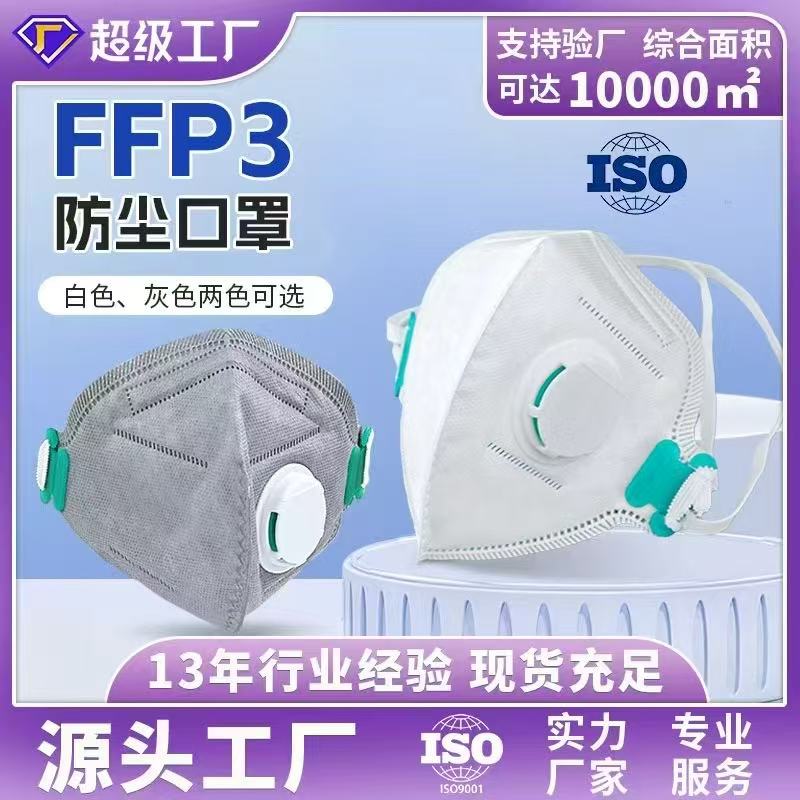
- Comfort-focused design: an exhalation valve is intended to reduce breathing resistance during exhalation.
- Professional applications: suited to workplaces and other environments where airborne particles are a concern.
- Supply options: product specifications, samples, packaging options, and bulk supply details are available on request.
Any numeric filtration or performance figure should be confirmed against the test report for the exact model before it is published or used in a purchasing decision.
1. What “FFP3” actually certifies
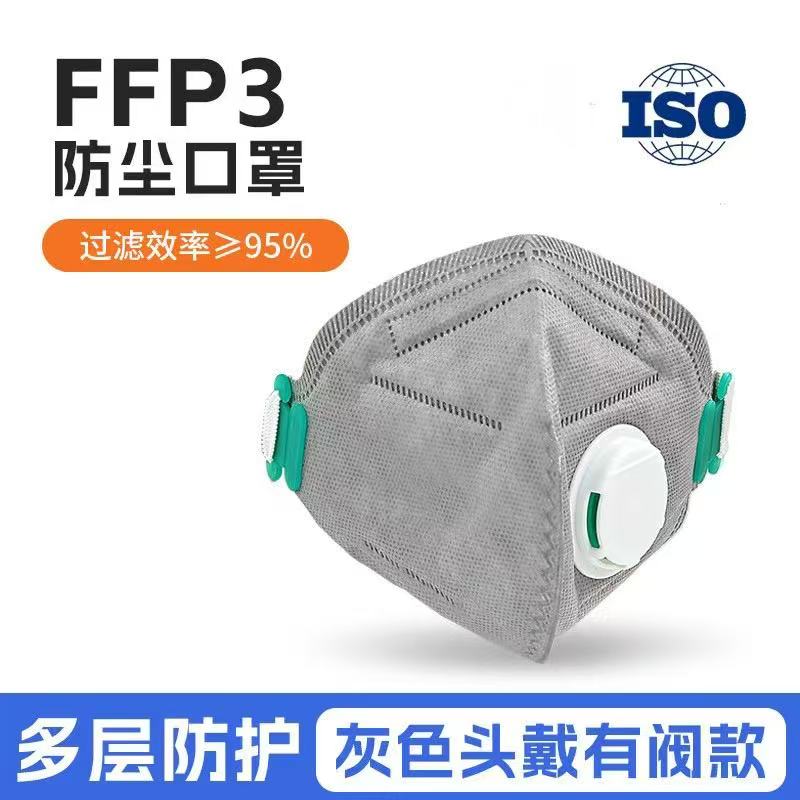
FFP stands for “filtering facepiece,” and FFP1, FFP2 and FFP3 are the three classes of particle-filtering half masks defined by the European standard EN 149:2001+A1:2009. The classes are not marketing tiers; each one carries a defined filter penetration limit measured at a fixed airflow of 95 litres per minute. FFP1 must filter at least 80% of the challenge aerosol, FFP2 at least 94%, and FFP3 at least 99%. The protection offered by a higher class includes that of the classes below it.
The standard tests the filter material against two different aerosols: sodium chloride and paraffin oil, representing solid and liquid particles respectively. A mask that passes one but not the other does not qualify for the class. EN 149 also lays down inward-leakage limits and marks each device as either “NR,” meaning single-shift use only, or “R,” meaning reusable for more than one shift. A correctly marked product therefore carries its class, the standard and year, and any applicable option codes, for example “EN 149:2001+A1:2009 FFP3 NR D.”
The practical lesson for buyers is narrow and useful: the class is only meaningful when it is attached to a specific model with a specific test report behind it. “FFP3” printed on a carton is a claim. “FFP3, model X, test report number Y, from laboratory Z, dated and still valid” is evidence. Ask for the second, and read it before you commit to the first.
2. Filtration efficiency and the test that proves it
It is worth understanding what the headline number actually measures, because the way it is quoted is often the first sign that a supplier does not understand their own product. Under EN 149 the measured quantity is penetration, the proportion of particles that get through, and the class limits are expressed as maxima: no more than 1% penetration for FFP3, no more than 6% for FFP2, no more than 20% for FFP1. “At least 99% filtration” is simply the same fact stated in terms of efficiency rather than penetration.
Two details follow from this. First, the test is run at 95 litres per minute, a demanding breathing rate, and it is run against both solid and oily aerosols. A claim that quietly omits one of those conditions is incomplete. Second, the figure describes the filter material under laboratory conditions. It is not a promise about the aerosol a wearer will actually encounter, and it is certainly not a measurement of how many viruses the wearer will avoid. A responsible supplier states the class, the standard, and the tested penetration, and stops there rather than extending the number into clinical or survival claims that the test was never designed to support.
For the exact model you are considering, the parameter to verify is the filter penetration result for both aerosols at the tested flow rate, quoted from the applicable test report. Where that figure is not yet available, it should be treated as unconfirmed rather than assumed from the class label.
3. Fit and inward leakage: the number buyers forget
A respirator is the only common category of protective equipment where the best possible filter can still fail. Air follows the path of least resistance, and if there is a gap around the nose, cheeks or chin, a substantial share of each breath bypasses the filter entirely and enters through the leak. A 99% filter worn with a poor seal can deliver protection far below its rated figure.
This is why EN 149 tests inward leakage as a separate requirement. For FFP3 the total inward leakage across a panel of wearers must be low, and the standard also caps the average leakage for individual wearers so that the result cannot be carried by a few well-fitting faces. The exact figures are set out in the standard, and they matter more to real-world performance than most buyers realize.
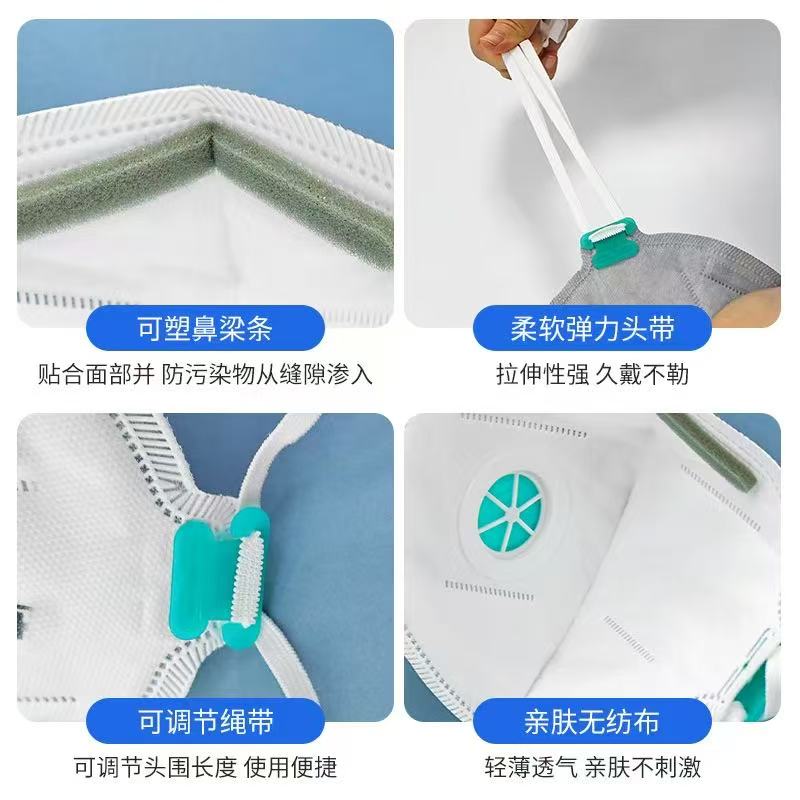
The implications for sourcing are practical. A supplier should offer a size range, not a single universal size, and should be able to explain how the nose clip and the nose foam work together to close the gap above the cheeks. Users should perform a seal check every time the respirator is donned, and facial hair or eyewear that crosses the sealing surface can compromise the fit. A tight-fitting respirator cannot be treated as one-size-fits-all, and a supplier who claims otherwise is telling you they have not thought carefully about leakage.
4. Valved or unvalved: what the valve changes
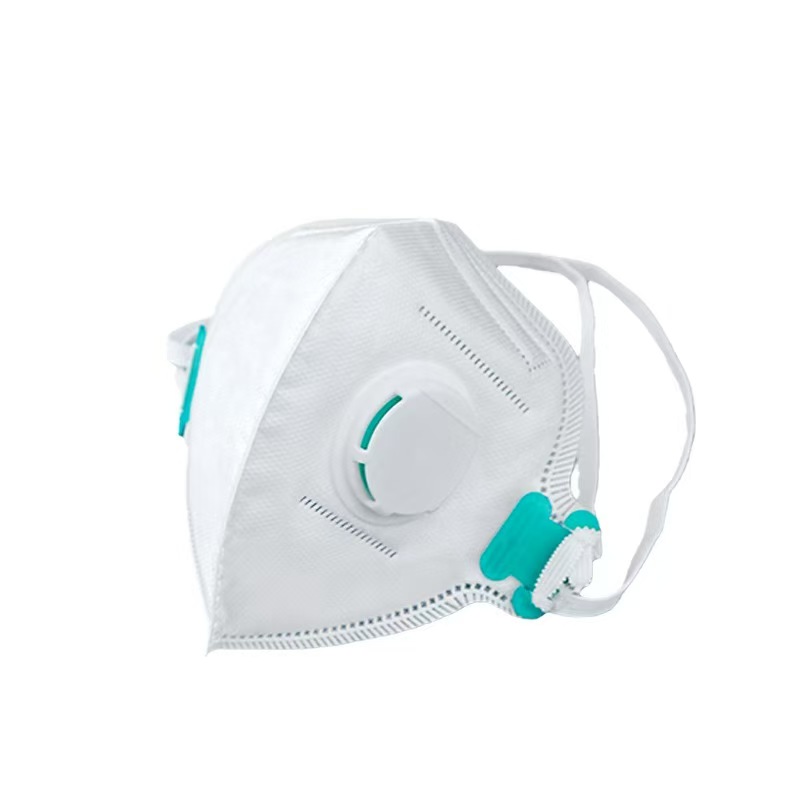
The exhalation valve is the most misunderstood feature on a respirator. It does not improve filtration. Its purpose is one-directional and simple: it opens when the wearer breathes out, reducing exhalation resistance and helping warm, moist air escape, which most wearers find more comfortable and which can reduce heat and humidity build-up during long shifts.
What the valve changes is the direction of protection. A valved respirator is designed primarily to protect the wearer by filtering inhaled air. Because exhaled air can pass through the valve with less resistance, a valved mask provides weaker source control than an equivalent unvalved model: if the wearer is infected, the valve may allow more of their exhaled particles to escape into the surrounding space. In settings where source control matters, such as some healthcare or shared clinical environments, an unvalved respirator, or a valved respirator combined with an additional covering, may be required by the applicable guidance.
For buyers, this is a market-selection decision rather than a cost decision. Industrial and dust-heavy applications often favour the comfort of a valve; environments where protecting the surrounding people is the priority often do not. Confirm which configuration your destination market and end users expect before specifying it in a listing or a purchase agreement.
5. FFP3 vs N95 vs KN95: different systems, not one ranking
It is tempting to arrange respirators on a single ladder and assume FFP3 sits above N95. That comparison is easy to make and largely meaningless, because the classifications belong to different regulatory systems with different test methods, different aerosols, and different certification processes.
N95 is a United States certification issued under NIOSH’s 42 CFR Part 84. The “95” denotes a minimum filtration efficiency of 95% against a sodium chloride aerosol at the most penetrating particle size, tested with a defined loading. NIOSH also certifies N99, N100 and the oil-resistant R and P series at 95, 99 and 99.97 percent. FFP3, by contrast, is a European class under EN 149 with a minimum 99% efficiency against both salt and oil aerosols. KN95 is a Chinese classification under GB 2626, again with its own test protocol. The nominal percentages are genuinely different numbers produced by genuinely different methods, so treating them as a clean hierarchy misleads.
What actually matters is jurisdiction. A product that must satisfy NIOSH for the United States is not interchangeable with a product that must satisfy EN 149 for the European Union, and a supplier who can support one market may not be able to support both. The right question is not “which is better,” but “which classification does my destination market require, and can this supplier document it for the exact model?”
6. A respirator is a system, not just filter paper
Ask an inexperienced buyer to describe a respirator and they will describe the filter. Ask a manufacturer and they will describe a system, because filtration efficiency is the outcome of several components working together, and any one of them can degrade the result.
The filter media is the core, but its performance depends on how it is layered, how the layers are bonded, and how penetration is controlled during high-speed production. The nose clip and the nose foam determine whether the critical area above the cheeks seals. The head harness, and whether it uses over-the-head straps or ear loops, sets the tension that holds the facepiece against the face; elastic that relaxes too quickly, or buckles that slip, cause leakage that increases over a shift. The valve must seal closed on inhalation and open cleanly on exhalation. The seams, the folded or cup-shaped forming, and the welding of the strap attachments all have to survive the forces of donning and doffing without tearing.
This is why sample-to-production consistency is a real sourcing question rather than a formality. A supplier whose hand-made sample differs from its mass-production output, in weight, layer count, harness tension, or forming, has not demonstrated anything by sending you the sample. The specifications that make a respirator work have to hold across the whole order, and the quality-control process is what keeps them there.
7. Regulatory pathways: EU PPE 2016/425, NIOSH, and where masks differ
A particulate respirator such as an FFP3 mask is personal protective equipment, and in the European Union it is governed by Regulation (EU) 2016/425 rather than by medical-device legislation. To carry the CE marking legally, a respirator must follow the conformity-assessment route for its risk category. Because protecting the respiratory tract against harmful particles addresses a very serious risk, FFP3 respirators fall into Category III, the most demanding category. Category III requires an EU type-examination by a notified body followed by a conformity-to-type procedure, either product checks at random intervals or quality assurance of the production process. The CE marking is then accompanied by the identification number of the notified body involved, and an EU type-examination certificate has a maximum validity of five years.
For the United States, the equivalent gate is NIOSH approval under 42 CFR Part 84, which includes not only filter testing but also approval of the manufacturing facility’s quality-control plan and periodic product audits, so that certification is tied to the factory, not just the design. A supplier who can route a product through both systems is genuinely more capable than one who can only point to a self-declared certificate.
It is equally important to know where a mask is not a respirator. Medical and surgical masks are regulated as medical devices, not as PPE: in the United States they fall under the FDA framework, and in the European Union under the medical-device rules, with their own standards and their own performance categories. A surgical mask is a loose-fitting device intended largely as a barrier and for source control; it is not certified to protect the wearer against inhalation of fine particles and does not carry a respirator class. When a supplier blurs these categories, treat it as a warning. Confirm the regulatory status of the exact product for the exact market, and do not let an attractive price on “surgical” product be presented as an FFP3 substitute.
8. The documentation trail buyers should receive
Because so much of a respirator’s value is invisible, the paperwork is part of the product. A reliable supplier can assemble a documentation trail before the first order rather than after a complaint, and that trail is the fastest way to compare suppliers who otherwise look identical.
At minimum, expect the model identification that will actually be supplied; the applicable test report for that model, naming the standard and its revision; the conformity documentation, such as the EU type-examination certificate and the notified body’s identification number, or the NIOSH approval number, as appropriate to the destination market; the marking and labelling content that will appear on the device and its packaging; and the user instructions. Ask specifically whether the certificate covers the current production configuration, since a certificate for an earlier version of the product does not automatically cover a redesign.
Then close the loop with a sample. The sample should match the documented model, and the production units should match the sample. Buyers who compare the approved sample against the first commercial shipment, in build, weight, harness, and packaging, catch more problems than buyers who trust a certificate alone. Documentation proves eligibility; consistency proves execution, and it is surprisingly common for a supplier to have the former without the latter.
9. OEM/ODM and private label
For distributors and brands that want their own identity on the shelf, OEM and private-label capability is the difference between reselling a commodity and building an owned product line. The scope of customization is where suppliers separate, so it is worth testing that scope early rather than discovering its limits after a launch.
Typical private-label work covers logo printing on the facepiece or the packaging, custom artwork and retail cartons, colour options for the shell and the valve, and configuration choices such as valved or unvalved construction and the size range in the carton. ODM work goes further, into adjustments of the product itself, and it is best supported by a manufacturer that controls its own tooling and production rather than reselling another factory’s output.
Two questions reveal a great deal about a supplier’s real capability. The first is artwork control: how is your logo approved and locked, and how is a misprint prevented from reaching the whole production run? The second is change control: what happens to your approval when the supplier changes a material or a supplier of a component? A capable partner welcomes these questions, because the answers are what keep a branded order consistent from the first shipment to the tenth. Buyers evaluating factory capacity, and whether inspection is possible, should raise that directly; statements about factory scale are only meaningful when they can be verified.
10. Packaging, labelling and logistics
Packaging is where compliance and commerce meet. The device and its packaging must carry the marking that the applicable standard requires, including the class, the standard and the manufacturer’s identification, and it must be legible on every unit, not only on the outer carton. For private-label orders, the retail packaging also has to satisfy your own market’s labelling rules, which may differ from the manufacturer’s home market.
On the logistics side, respirators are bulky relative to their value, so carton configuration, inner packing, and the ratio of units to carton volume drive freight cost as much as the unit price does. Ask how the product is protected against moisture and compression, how the cartons are marked, and whether the supplier can produce retail-ready packaging rather than only bulk inner packs. A supplier who understands landed cost, not just ex-works cost, will usually be the better partner, because their advice reduces your total expense instead of merely lowering their invoice.
11. MOQ, pricing and total cost of ownership
Minimum order quantities are the point where a supplier’s capabilities become concrete. A low MOQ is convenient, but if it comes with a different production line, a different material, or relaxed quality control, the saving is illusory. Try to understand what the MOQ corresponds to: a full production batch, a tooling run, or a shared order. The answer tells you how stable the specification will be.
Pricing should be compared on a landed, delivered basis and next to a consistent specification, not against a different class or a different construction. An FFP3 valved mask and an FFP2 ear-loop mask are not price alternatives; they are different products for different requirements. Once specifications are equalized, the more useful comparison is total cost of ownership: unit price plus freight, duty, inspection, the cost of rejected or recalled lots, and the cost of switching suppliers if the first one fails. On that basis, a supplier who is slightly more expensive but reliable and well documented is frequently the cheaper choice, because the expensive surprises in this category are almost never in the unit price.
Common pitfalls buyers should avoid
- Buying on price before comparing specifications. The lowest quote almost always corresponds to a different construction, a lower class, or a lighter build, and the comparison is not like for like.
- Trusting a number without its source. A filtration percentage without a named standard, test report and model is a slogan, not a specification.
- Forgetting that fit is protection. A high-efficiency filter with a poor seal is a low-protection respirator, so size range and seal quality belong in the evaluation.
- Assuming a certificate transfers to every market. A CE marking for the EU is not a NIOSH approval for the US, and the two are not substitutes.
- Treating a surgical mask as a respirator. They are different device categories with different intended uses and different regulatory routes.
- Skipping the sample-to-production check. The sample proves intent; only the production audit and the first shipment prove consistency.
- Overlooked source control. Where the valve matters for the people around the wearer, a valved product may be the wrong choice for that market.
Conclusion
FFP3 is a hard-won classification, but it is only as good as the evidence and the consistency behind it. The suppliers worth partnering with are the ones who can show the test report for the exact model, explain the difference between filtration and fit, understand which regulatory route your market requires, and demonstrate that the production units match the approved sample. Everything else, including the price, is easier to negotiate once those three pillars are in place.
B2B buyers evaluating an FFP3 respirator programme are welcome to contact us with their destination market, intended application, preferred configuration and estimated volume. We can share model specifications, available test documentation, packaging and private-label options, and sample arrangements, so that the decision is made on evidence rather than on a label.
Frequently Asked Questions
What is the difference between FFP3 and N95?
They are classifications from different regulatory systems. FFP3 is a European class under EN 149 with a minimum 99% filtration efficiency against salt and oil aerosols; N95 is a United States NIOSH certification under 42 CFR Part 84 with a minimum 95% efficiency against a defined aerosol. The percentages come from different test methods and are not a direct, complete comparison of real-world protection.
Is an FFP3 mask better than an N95 mask?
Neither is universally “better.” The relevant question is which classification your destination market requires and whether the supplier can document it for the exact model. Actual protection also depends on fit, leakage, product quality and correct use, not on the class label alone.
Does a valved respirator protect against airborne particles?
A valved respirator can help reduce the wearer’s exposure when the filter and facial seal perform as intended, because the valve mainly reduces exhalation resistance. However, the valve may allow more exhaled particles to escape, so it may be less appropriate where source control is required.
Can a respirator guarantee complete protection?
No respirator should be described as guaranteeing complete protection. Protection depends on the product’s verified performance, the fit, correct use, exposure conditions, and other relevant prevention measures.
What should I check before buying an FFP3 respirator in bulk?
Check the exact model, its documented filtration performance, the fit and construction, the packaging, and the supplier’s ability to keep production consistent with the approved sample. Confirm that any advertised numeric performance claim is supported by documentation for the product actually being supplied.
What is the difference between a respirator mask and a surgical mask?
A respirator is designed to filter airborne particles and, when properly fitted, to reduce leakage around the face; it is regulated as personal protective equipment. A surgical mask is generally loose-fitting, is regulated as a medical device, and is intended for different protective purposes, so the two should not be treated as interchangeable.
Where can I find a reliable FFP3 respirator mask supplier?
Request a product specification sheet, the relevant test documentation, and a sample of the exact model, and compare the delivered product against the documented specification before placing a larger order. A supplier who can provide all three is easier to trust than one who cannot.
References
- European Committee for Standardization (CEN). EN 149:2001+A1:2009 – Respiratory protective devices – Filtering half masks to protect against particles – Requirements, testing, marking. Brussels: CEN, 2009.
- European Parliament and Council of the European Union. Regulation (EU) 2016/425 on personal protective equipment and repealing Council Directive 89/686/EEC. Official Journal of the European Union, 31 March 2016.
- U.S. Department of Health and Human Services, National Institute for Occupational Safety and Health (NIOSH). 42 CFR Part 84 – Approval of Respiratory Protective Devices. Code of Federal Regulations, Title 42.
- National Institute for Occupational Safety and Health (NIOSH). N95 Respirators and Surgical Masks. NIOSH Science Bulletin, Centers for Disease Control and Prevention.
- U.S. Food and Drug Administration (FDA). Surgical Masks (21 CFR 878.4040) and N95 Respirators. FDA, Center for Devices and Radiological Health.
- U.S. Occupational Safety and Health Administration (OSHA). Respiratory Infection Control: Respirators Versus Surgical Masks. OSHA Publication 3219.
- Standardization Administration of China. GB 2626 – Respiratory protection – Non-powered air-purifying particle respirator.